

A Challenging Housing Market May Strengthen the Case for Factory-Built Housing
Zelman & Associates reports pricing pressure accelerating in the conventional homebuilding market. Chris Nicely examines what that means for manufactured and factory-built housing — and why a lower factory cost alone is not enough.
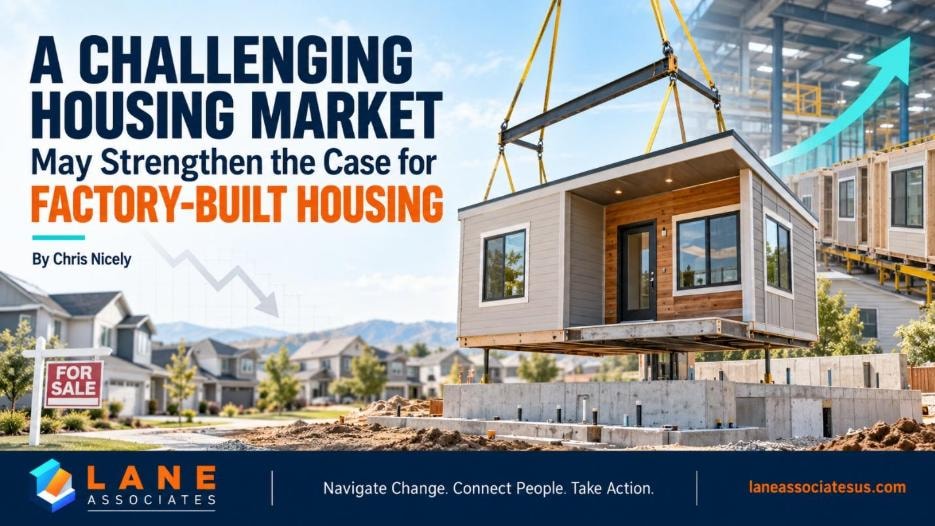
A Challenging Housing Market May Strengthen the Case for Factory-Built Housing
By Chris "Lane" Nicely | September 25, 2026
The latest Zelman & Associates Homebuilding Survey carries a direct title: "Challenging Trends Continue." Its preliminary findings describe August home orders as relatively steady, but with pricing pressure accelerating.
That is an important distinction. Buyers have not disappeared, but the price, and monthly payment, required to bring them into the market is becoming increasingly difficult to achieve.
Zelman's monthly survey represents approximately 15% of production single-family home sales and covers virtually all of the nation's 75 largest housing markets. It tracks orders, starts, inventory, pricing power, construction costs and builder expectations, providing an early look at conditions before many government statistics are released.
Other industry data reinforces Zelman's caution. The August NAHB/Wells Fargo Housing Market Index remained at a low reading of 35. Thirty-five percent of builders reported cutting prices, with an average reduction of 6%, while 63% were using sales incentives. August also marked the 16th consecutive month in which at least 30% of builders reported reducing prices to support demand, according to NAHB.
For factory-built housing, these conditions present both an opportunity and a warning.
The Opportunity Is Straightforward
When conventional builders must reduce prices, buy down interest rates or offer other incentives to reach qualified buyers, construction efficiency becomes more important. Manufactured, modular and other systems-built methods can reduce construction time, improve material utilization, provide greater cost predictability and lessen dependence on increasingly scarce on-site labor.
Factory-built housing also creates opportunities to offer smaller homes and more attainable price points, products that much of the conventional market has struggled to deliver profitably. In a market where buyers are increasingly payment-sensitive, that difference can be meaningful.
But the Warning Is Real
The Zelman findings should not be interpreted to mean that factory-built housing automatically wins whenever conventional housing slows.
A lower factory cost does not eliminate the price of land, site development, transportation, installation, utility connections, permitting, financing or local regulatory delays. If those costs are not controlled, much of the factory advantage can disappear before the home reaches the consumer. Manufactured housing also faces financing, zoning and appraisal barriers that conventional builders may not encounter to the same degree.
The lesson is that our industry must focus on the total delivered cost and monthly housing payment, not simply the price of the home leaving the factory.
New Partnership Opportunities
The current market may also create new partnership opportunities. Conventional builders and developers under pressure to reach lower price points may be more willing to consider modular construction, CrossMod homes, manufactured-home subdivisions, infill development and mixed communities using more than one construction method. Factory-built producers should not view every site builder as a competitor; in some cases, they may be a future customer or development partner.
Zelman's report is a warning that the housing market remains difficult; but it is also evidence that the traditional homebuilding model is struggling to match what many buyers can afford.
An Opening, Not a Guarantee
That does not guarantee success for factory-built housing. It gives us an opening.
To take advantage of it, the industry must do more than promote a lower-priced product. We must combine efficient construction with appropriate land, workable financing, cooperative local officials and a clear understanding of the customer's monthly budget.
The market is telling housing providers that buyers need something different. Factory-built housing has the tools to respond, if we can turn production efficiency into a genuinely attainable, complete housing solution.
Explore Topics
Written by
Chris "Lane" Nicely
Content creator and writer sharing insights and stories.


